CS:GO Majors are supposed to be a raucous celebration of the game. The place where the best teams duke it out, in a desperate bid to establish themselves as the apex predator. There is no such as a free round within this theatre.
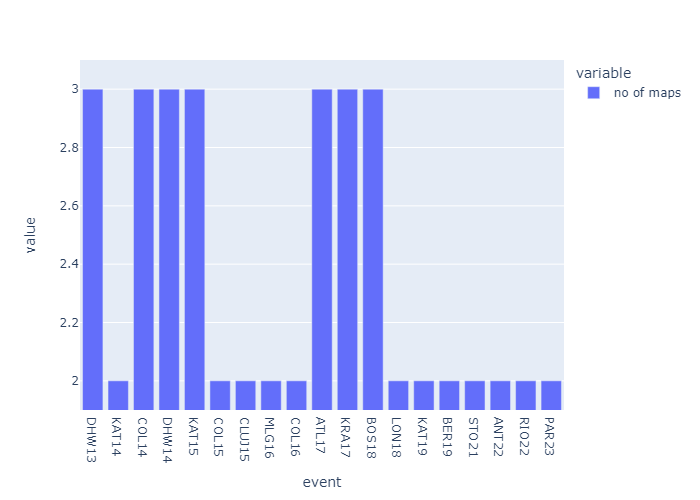
Yet Boston 2018 was the last CS:GO major final to ever reach 3 maps.
7 consecutive major finals, where the loser could not muster one map.
What is going on?
What does a good major look like?
To me, a good major gradually becomes more competitive. Each stage delivers closer and closer matches - a gradual crescendo into the grand finals.
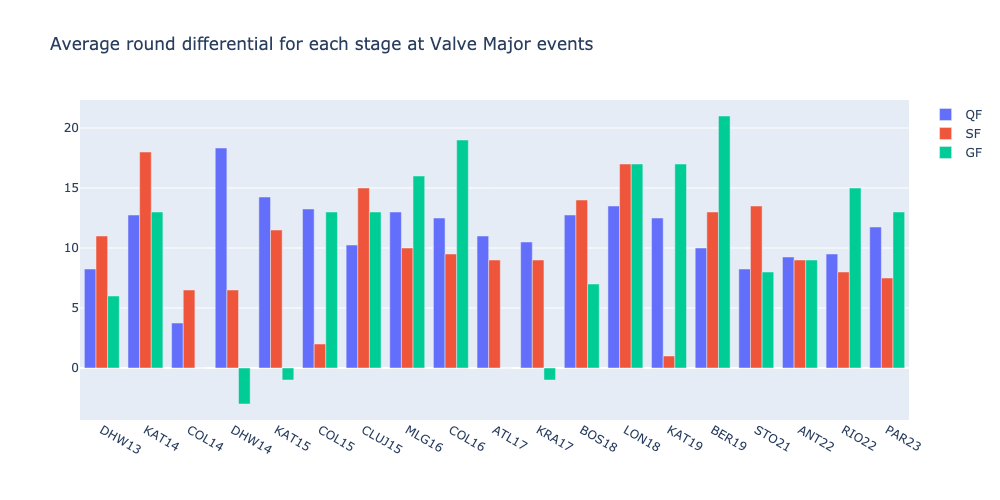
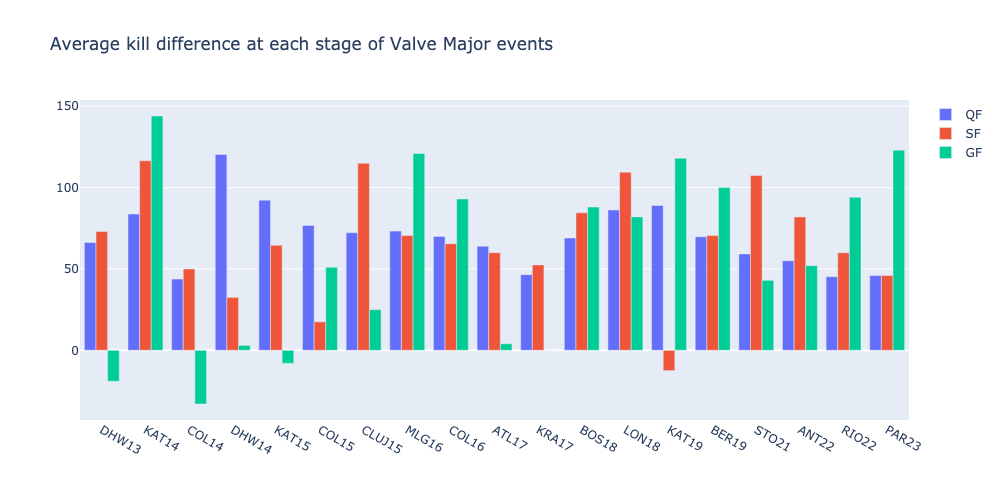
Atlanta 2017 is considered an iconic (if underrated) major. The above graph shows why. A competitive event, where each stage got incrementally closer - building to a grand final where the teams were inseparable, winning the same number of rounds across the series. The story too was here: the legends of Virtus.Pro, seeking a 2nd major vs an Astralis trying to establish themselves.
Krakow 2017 is interesting. Some pan the event for the underwhelming grand finalists. Maybe. Were the matches a close affair throughout? Yes.
Cologne 2014 was a seminal event. The game was experiencing a unique influx of users. The event would be so memorable that ESL would re-host it every year, moving it from an expo at GAMESCOM to a full arena. Cologne doesn’t follow the perfect pattern, as the semis are less competitive than the quarters. However, let’s put this within context - this was one of the top 5 most competitive semi-finals. The grand final was another 0 round difference affair.
Round differential during Semi Finals at Valve Major events
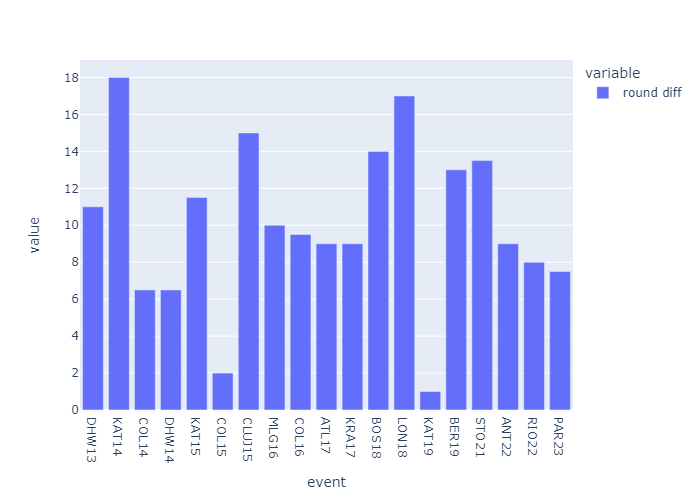
Some grand finals even managed negative round differentials - the loser winning more rounds across the series.
Berlin 2019 is exactly the opposite of what a major should be. The quarter finals are fine, but the semi-finals were less competitive, culminating in the biggest grand finals defeat in major history. It was also a result that was entirely predictable.
Cluj-Napoca 2015, MLG Columbus 2016, and Cologne 2016 look like bad historical majors. Compared to the ones around them, I must agree - coldzera’s jumping double, or s1mple’s flying AWP doesn’t make the event great. The latter two events are saved by individual matches, but those majors were full of weak spots, especially the grand finals.
Katowice 2019 was oh-so close to greatness. It had the closest semi-finals in major history. ENCE and Na’Vi duked it out brutally, the xseveN vs s1mple 1v1 symbolising a great Goliath being stoned by David. MiBR managed a close map against the savages of Astralis.
And then came the grand finals. sigh. This was David vs Goliath 2, and this time, David was shown no mercy.
Speaking of Astralis
In 2018, Astralis set history by becoming the first team to not drop a map within the play off stages at a major. They would go on to repeat this feat 2 more times. Since then, Na’Vi and Vitality would also repeat this feat.
To put this more into perspective - this was an event that didn’t happen for 11 majors, and then it happened 5/7 times.
Vitality faced relatively easy opposition in Paris. Na’Vi didn’t face any world beaters: two lineups on the precipice of changes, and Gambit, that still faces struggles in 2023 to establish themselves.
Katowice and London was much the same story, but Berlin wasn’t. Astralis faced one of the most dominant lineups in Liquid, and NRG, a future no.1 team in the world. NRG had even 2-0’d Astralis in a BO3 earlier on in the event.
Sometimes majors are destined to be boring. Nothing was going to stop the brute force dominance they enacted for three majors.
At the same time though, Na’Vi and Vitality repeating this feat should worry us.
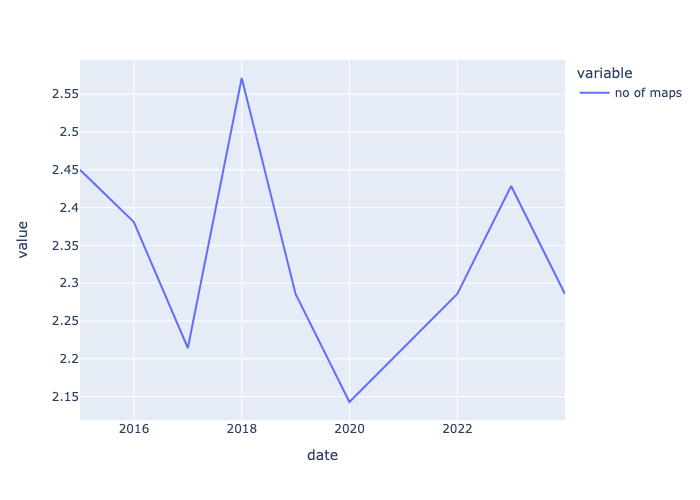
We’re getting less maps
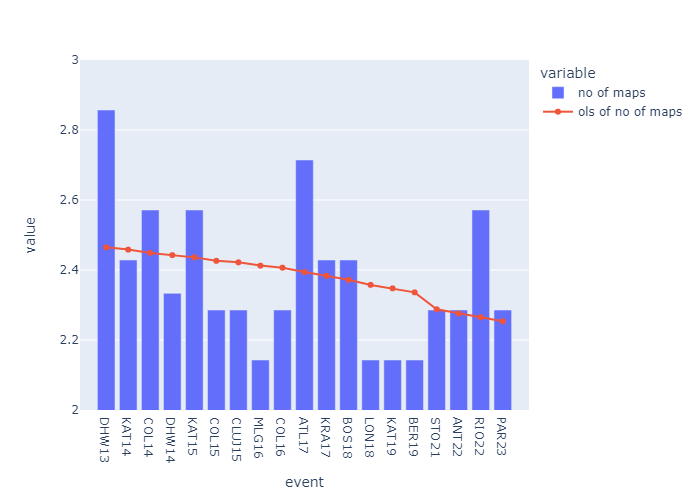
With the exception of Rio, we’re getting less BO3s than before. London to Berlin was a particularly awful run (there was one series in the entire play-off series that had 3 maps), but Stockholm, Antwerp and Paris weren’t much better.
Cologne 2015 to Cologne 2016 wasn’t brilliant either. It is salvaged by there being three majors a year, so this encompasses half a year, as opposed to the multi-year level of turgidity we’re seeing.
Some of the worst maps in Major play-off history
Natus Vincere vs NiP, semi-final of Cluj 2015
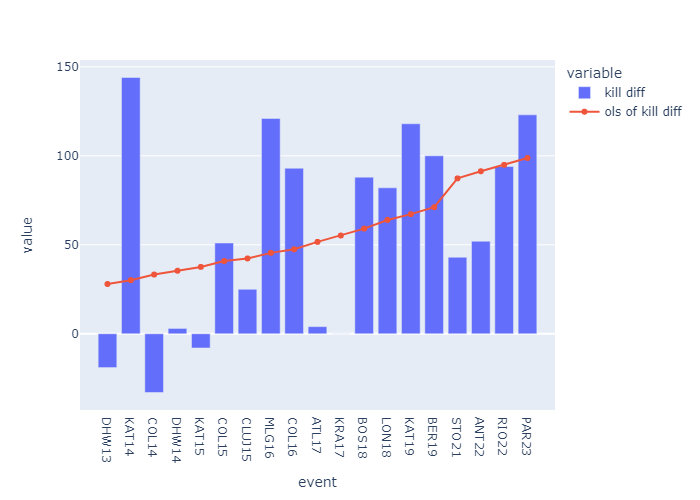
NiP shouldn’t have been here. TSM were tournament favourites, but NiP were their kryptonite and delivered here1. Na’Vi then promptly showed us why NiP shouldn’t have been there, with this match having the largest kill differential ever at a major.
Virtus Pro vs Keyd, quarter-finals of Katowice 2015
Keyd could not afford to make it to the major. Donations, from pros like like flusha helped get them here. They played with heart, and made it to the quarter-finals. But Virtus.Pro did give them any sympathy. VP delivered the biggest round differential, and the 2nd worst kill differential in Major history - despite Keyd winning a map. We all know where the story of FalleN and fer would end up at, but it wasn’t obvious here.
Gambit vs fnatic, quarter-finals of Cologne 2016
Looking at the scoreline, you’d never believe that the core of Gambit would win a major. This match was within the top 5 biggest kill and round differentials at a major.
And some of the best
ENCE vs Natus Vincere, semi-finals of Katowice 2019
This had the lowest round and kill differential of any major match. But… this was because ENCE lost more rounds than Na’Vi. Nonetheless, we were given two exciting maps, were the underdog won.
fnatic vs Ninjas In Pyjamas, grand final of Cologne 2014
A grand final where the round differential was zero, and the losing team had more kills. Iconic.
Rio and Boston - why are they treated differently to what the data suggests?
Boston 2018 is considered an all-time great major. Meanwhile, Rio 2022 is considered one of the worst.
Rio’s quarter and semi-finals are more competitive than Boston’s. The round differential is lower, and Rio overall has more maps played across the major.
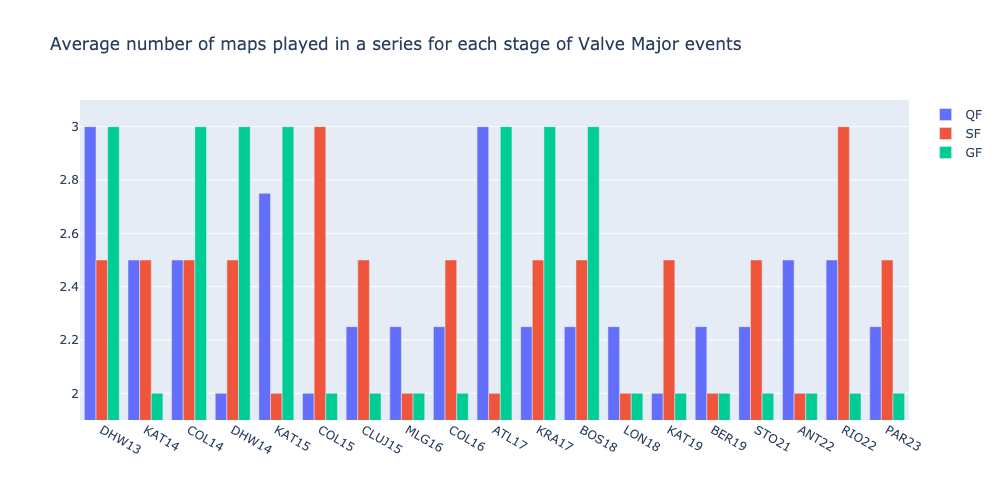
So, why do people look down on Rio? Here are some of the factors.
- A lack of a crowd for non-FURIA matches
- Despite an explosion of demand, the arena failed to fill up for non-FURIA matches. The grand finals in particular were absent.
- The favourites were eliminated early
- FaZe, Vitality, Liquid and G2 didn’t back it to the play-offs (G2 were eliminated in the RMR).
- And the final was boring.
- Outsiders played a boring style of Counter-Strike, for one.
- And the game wasn’t close. A two mapper, where Heroic managed 17 rounds. Heroic failed to show up.
And why do people consider Boston great?
- The story of the winning team
- The first (and only) NA team to win a major.
- On home soil.
- As an underdog.
- The last map
- Inferno was one of the most intense maps of CS:GO, ever. A dominant start, followed by the underdogs running it back. Who can forget the 15-14 round.
Boston’s narrative is built on the finals. If we exclude them, Rio is the more competitive major.
It’s even worth noting that in the kills department, Cloud9 blew FaZe out of the water across the final, to the point where the kill differential is higher in Boston than in London. Sometimes even if the first two maps are boring, as long as you make it to a close third, the perception is different.
On average, have majors changed?
| The Yearly Average of the number of maps played at play-off stages of Valve Major Events | The Yearly Average of the kill differential and round differential played at play-off stages of Valve Major Events |
|---|---|
 |
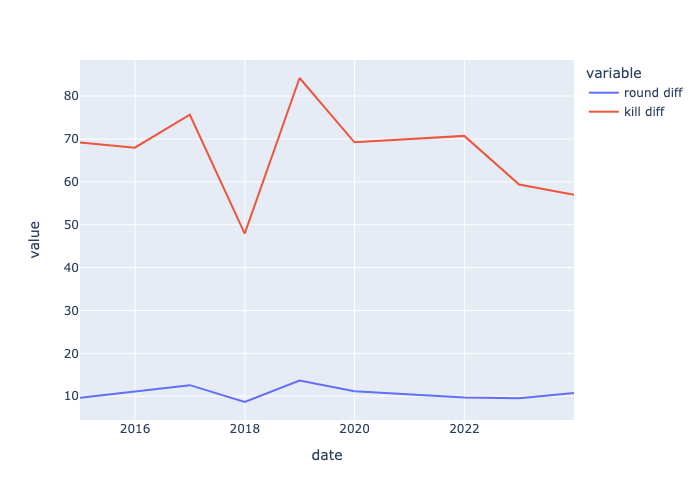 |
When we look at the averages, it doesn’t look so bad. The historical lows of 2018 are slowly recovered from.
So why aren’t we treating them as good majors?
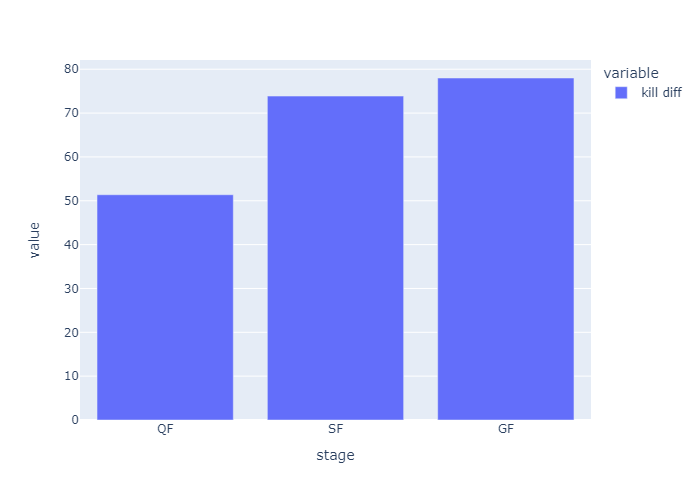
| Kill diff average per stage before 2018 | Kill diff average per stage after 2020 |
|---|---|
 |
 |
| Round diff average per stage before 2018 | Round diff average per stage after 2018 |
|---|---|
 |
 |
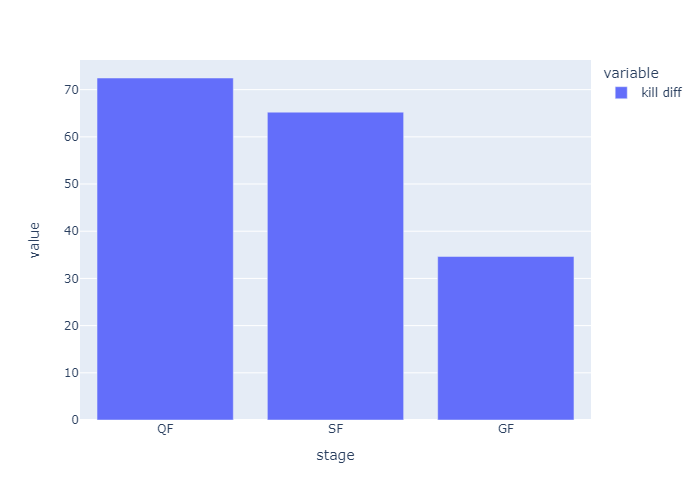
Averaging the majors before 2018, and the majors after 2020 (so as to exclude the worst majors), and splitting it by stage, we can see the problem. As mentioned earlier in the article, the right way for a Major to trend is for each stage to be more competitive. Before 2018, this was the average. But after 2020 (and 2018, for that matter), this does not happen. The Grand Finals of now are even less competitive than the quarter-finals of before.
Conclusion
Each stage of a Major isn’t judged equally. We make the biggest judgement on how good a Major was based on the Grand Final.
| The number of maps played in Grand Finals at Valve Major events | Kill differential during Grand Finals at Valve Major events | Round differential during the Grand Finals at Valve Major events |
|---|---|---|
 |
 |
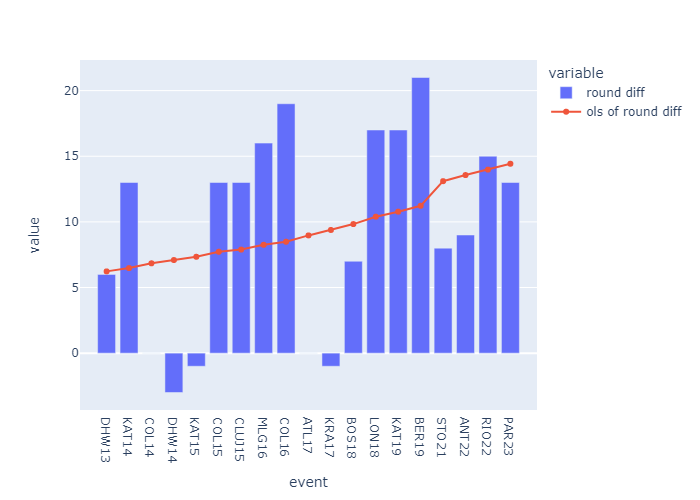 |
Grand finals, on average, are far less competitive than before. The most competitive recent majors, Stockholm and Antwerp, were still two map affairs. The tension that is built up by it going to the 3rd map, the tension from feeling that both teams are capable of notching tallys on the map counter - it never arrives.
Adding the changes in how rounds are played (Have CS Rounds gotten slower), we have a unique blend of slow, drawn out executions right at the most critical stage of the game. Any excitement is bled out, inconsequential save after save. The victor is playing with its food.
Majors used to self-correct themselves. The stretch from Cologne 2015 to Cologne 2016 concluded with an exciting Atlanta. But that pattern has been stopped. Whether COVID, changes in the way the game is played, or some other factor played a role, I cannot say.
A potential reason, that is currently under the spotlight, is the format of major events. ELEAGUE’s 2017 Atlanta Major was the first major to use the Swiss format. The competitiveness of the two initial Swiss events indicates that something was working here. Even since Boston though, something hasn’t been working as well as it should be. People have noticed weaker and weaker teams making it to the play-off stage, and the quality of the games are suffering as a result.
As with my previous article, we have a respite in CS2, and the major break it brings. Maybe the gameplay changes will bring us to a new Golden Age for Valve Major events. Maybe the discussions around formats might end up causing changes that end up with more competitive matches.
Time to wait.
-
While this is an upset in the traditional sense, the TSM players were in a dispute with the organisation, impeding their performance. https://twitter.com/fbyskov/status/660822085565030400. This dispute would lead to the foundation of Astralis. ↩︎